Does NAD+ treat Alzheimer's? Learn the latest research on NAD supplements for dementia
*IV Ketamine, NR, and NAD+ have been used clinically off-label for decades. They are not FDA approved for the treatment of any psychiatric or pain condition. All medical treatments carry risks and benefits that you must discuss with a doctor at Clarus Health to learn if these therapies are right for you.
Alzheimer’s disease is the leading cause of dementia and is projected to affect >150 million people by 2050. Nicotinamide adenine dinucleotide (NAD+) is a critical molecule in supporting brain health, and recent research suggests its importance preventing or treating dementia. However, simplistic “NAD⁺ boosters” claims are often misleading.
What is NAD+
NAD⁺ is a coenzyme that cells constantly recycle. It plays three major roles:
Energy metabolism: NAD+/NADH shuttles electrons so mitochondria can make ATP.
Importantly: NAD+ is not a vitamin-like “more is always better” molecule. Cells need balance, and many enzymes consume NAD+ as part of normal physiology.
This NAD+ balance is central to cellular resilience against oxidative stress, DNA damage, neuroinflammation, blood-brain barrier deterioration, impaired hippocampal neurogenesis, synaptic plasticity deficits, and neurodegeneration.
Clarus Health · NAD+ Therapy
Your brain runs on NAD+. Most people are running on empty.
If you're struggling with brain fog, fatigue, or fading focus — your cells are telling you something. IV NAD+ delivers directly where it's needed, with results most patients notice within 24 hours.
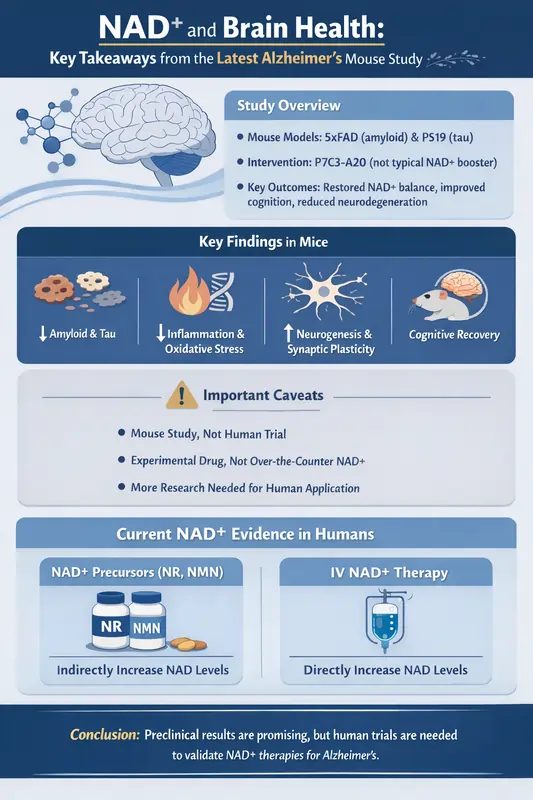
The latest study in collaboration between the United States and South Korea demonstrate several key findings:
Dementia severity correlates with NAD+ balance
The more disrupted NAD+ homeostasis, the worse the dementia
NAD+ balance is critical to supporting the blood brain barrier (BBB)
Oxidative damage and mitochondrial dysfunction disrupt cells in the brain's blood vessels, and NAD+ balance is essential to the health of these cells
In mice with Alzheimer's disease, normalizing NAD+ balance restored brain resilience and enabled recovery from advanced disease
NAD+ balance is lost with age, but Alzheimer's disease accelerates this loss
Do NAD+ Supplements Treat Alzheimer's?
Clearly, NAD+ has critical roles in brain health. However, NAD+ alone is not a treatment for Alzheimer's. While NAD+ is necessary for neuronal health, it needs to be balanced with other metabolically important interventions to decrease inflammation and, oxidative damage, and mitigate abnormal protein folding. Studies have demonstrated safety of boosting NAD+ levels even though cognition has not consistently improved.
It is important to discuss holistic memory care with your doctor, including sleep, exercise, metabolic health, alcohol moderation, inflammation management, etc. NAD+ balancing may be a valuable adjunct and will likely work better when other variables are optimized.
What is the Best NAD+ Supplement?
Many companies use deceptive marketing to suggest that their NAD+ supplement is superior. There is no supplement demonstrated to help with Alzheimer's, though some supplements have more research than others. Nicotinamide riboside (NR) has appreciable research and is available in oral and IV forms. Read our comparison of different NAD+ supplements here.
Is NAD+ Right for Your Longevity and Brain Health?
NAD+ supplementation may provide valuable benefits for neurodegenerative conditions, but it may have risks when used without supervision, including potential cancer risks. Many comprehensive longevity plans include a form of NAD+ supplementation, either IV or orally. Learn if NAD+ is right for you and speak with a doctor at Clarus Health today to start your longevity journey for healthy aging.
Take the First Step
Start feeling better today.
At Clarus Health, we treat the root cause — not just the symptoms. A free 15-minute consultation is where it starts.
Dr. Kaveh is a Stanford and Harvard-trained anesthesiologist and integrative medicine specialist. He has over 1,000,000 followers on social media and has guided hundreds of patients throughout transformative healing experiences. He is an authority on Ketamine, NAD, SGB, and genomics-guided therapies. He is a continuing medical education lecturer in the Bay Area.