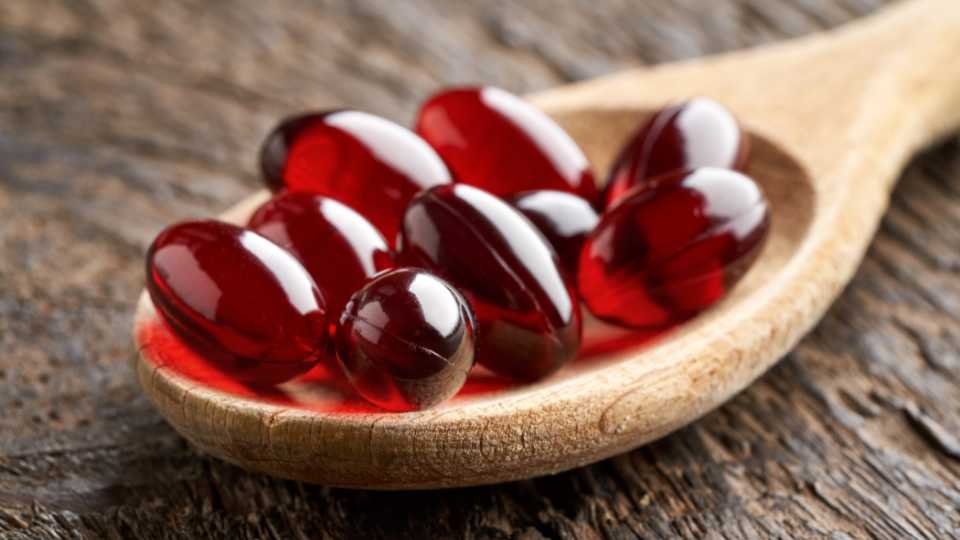
Does Astaxanthin actually help you live longer? It may depend on what form you take.
*IV Ketamine, NR, and NAD+ have been used clinically off-label for decades. They are not FDA approved for the treatment of any psychiatric or pain condition. All medical treatments carry risks and benefits that you must discuss with a doctor at Clarus Health to learn if these therapies are right for you.
Clarus Health · Longevity Medicine
Supplements are one piece. Your biology tells the rest.
Our advanced longevity panel tests 150+ biomarkers — inflammation, hormones, metabolic age, and cellular health — so you know exactly where to focus.
Does Astaxanthin Actually Work — or Is It Overhyped?
Astaxanthin has become extremely popular with my patients. It’s often marketed as an antioxidant that’s “100 times stronger than vitamin E,” and interestingly, that claim isn’t just marketing. In laboratory studies, astaxanthin’s antioxidant activity has been reported to be more than 100 times greater than that of vitamin E. https://pubmed.ncbi.nlm.nih.gov/33783748/
But here’s what most people don’t realize: not all astaxanthin behaves the same in the body. Some forms offer meaningful benefit, some offer far less, and in certain people, there are real risks.
By the end of this video, you’ll know which form of astaxanthin is worth taking, which to avoid, and who shouldn’t take it at all.
Astaxanthin has exploded in popularity over the last few years. Patients ask about it constantly. It shows up in longevity supplements, skincare products, and metabolic health protocols. The reason is simple: oxidative stress is one of the core drivers of aging, and astaxanthin is exceptionally good at addressing oxidative damage—when it’s used correctly.
Human studies suggest benefits for skin health, physical performance, cholesterol, diabetes, blood pressure, weight management, eye health, and possibly neurologic disease. These findings are summarized in an evidence-based review of human clinical trials. https://pubmed.ncbi.nlm.nih.gov/36999233/
Astaxanthin is a carotenoid, but it behaves very differently from vitamin C or vitamin E. Carotenoids are natural red, orange, and yellow pigments found in plants, algae, and some bacteria. They protect plants from light-induced oxidative damage, and they can do the same in humans. They are fat-soluble antioxidants, which is why astaxanthin should always be taken with a fatty meal.
What makes astaxanthin unique is its structure. It can span the lipid membrane of cells, allowing it to neutralize free radicals both inside and outside the cell membrane. This mechanism is described in detail here. https://pubmed.ncbi.nlm.nih.gov/19892350/
This is why astaxanthin often outperforms vitamin E in in-vitro studies. But potency in a lab does not automatically translate to real-world benefit.
Now let’s talk about forms, because this is where most people get it wrong.
There are two fundamentally different categories of astaxanthin on the market: natural and synthetic.
Natural astaxanthin comes primarily from the microalgae Haematococcus pluvialis. It’s also what gives Antarctic krill and wild salmon their red color. Natural astaxanthin is usually present as astaxanthin esters, which are more stable and appear to have better bioavailability.
You should always check the label. A high-quality product should clearly list H. pluvialis or Antarctic krill as the source.
Synthetic astaxanthin is produced from petrochemical sources. While it may look similar chemically, its molecular packaging is different, and that matters biologically. Most human clinical trials showing benefit used natural astaxanthin, not synthetic. Two supplements may both say “astaxanthin,” but they may behave very differently in the human body.
Now let’s talk about risks.
Astaxanthin is generally considered safe in the United States, but safety depends on dose, formulation, and the patient. Reported side effects include gastrointestinal symptoms such as increased bowel movements and red stool color, which are usually mild and reversible.
There are also anticoagulation concerns. Patients taking warfarin or other blood thinners should avoid astaxanthin due to the risk of increased bleeding. Small reductions in blood pressure, particularly diastolic pressure, have been observed, especially in Asian populations. Patients with low blood pressure or those already on antihypertensive medications should be cautious.
Astaxanthin can also improve blood sugar control, which is beneficial for many people, but patients on diabetes medications should monitor for hypoglycemia. There is insufficient safety data in pregnancy or breastfeeding, and safe dosing has not been established in children.
Product quality is another major concern. Purity, oxidation, and inaccurate labeling remain common problems, which is why third-party testing is essential.
Interestingly, Europe takes a more conservative stance. The European Food Safety Authority set a maximum recommended dose of 8 mg per day, even though higher doses have been used in clinical trials. https://efsa.onlinelibrary.wiley.com/doi/10.2903/j.efsa.2020.5993
Now let’s talk about dosing and what the research actually shows.
In patients with high cholesterol or pre-diabetes, 12 mg per day for 24 weeks improved lipid markers, with some studies using doses up to 18 mg per day. https://pubmed.ncbi.nlm.nih.gov/29384321/
In diabetes, 8 mg per day for 8 weeks improved glucose control and lowered blood pressure, with 10 mg per day showing potential additional benefits. https://pubmed.ncbi.nlm.nih.gov/40881644/
For weight loss and body composition, 20 mg per day combined with high-intensity training for 12 weeks improved lipid profiles and body composition. https://pubmed.ncbi.nlm.nih.gov/36678157/
For physical performance, doses of 12 to 24 mg per day have been associated with improved endurance and reduced lactate levels, likely through mitochondrial effects. https://pubmed.ncbi.nlm.nih.gov/38892683/
So should you take astaxanthin? It depends. In people with high oxidative stress, particularly those with metabolic disease, it may be a reasonable supplement. It’s used frequently in Japan for this reason. The side-effect profile is generally favorable when natural, third-party-tested forms are used.
As always, speak with your physician before starting or stopping any supplement or medication.
Dr. Kaveh is a Stanford and Harvard-trained anesthesiologist and integrative medicine specialist. He has over 1,000,000 followers on social media and has guided hundreds of patients throughout transformative healing experiences. He is an authority on Ketamine, NAD, SGB, and genomics-guided therapies. He is a continuing medical education lecturer in the Bay Area.