Ketamine for Chronic Fatigue Syndrome: Does it Work?
Can ketamine help chronic fatigue syndrome (ME/CFS)? See the latest research on ketamine for fatigue, pain, and brain fog.
*IV Ketamine, NR, and NAD+ have been used clinically off-label for decades. They are not FDA approved for the treatment of any psychiatric or pain condition. All medical treatments carry risks and benefits that you must discuss with a doctor at Clarus Health to learn if these therapies are right for you.

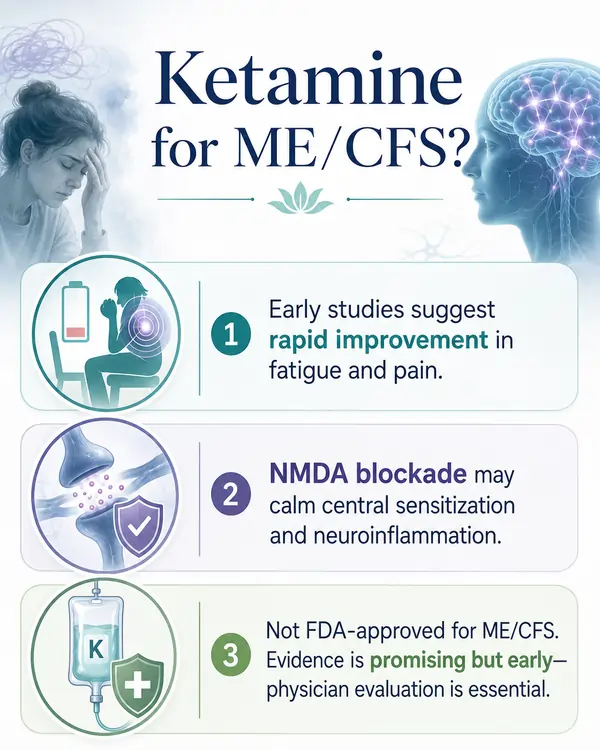
Chronic fatigue syndrome (ME/CFS), also called myalgic encephalomyelitis, still has no FDA-approved treatment, which is why researchers are now studying whether ketamine - an NMDA-receptor blocker used safely in medicine for decades - can reduce the fatigue, pain, and brain fog that conventional drugs miss. Here is what the current evidence says about ketamine for chronic fatigue syndrome.
The most direct evidence for ketamine and chronic fatigue syndrome
A 2026 proof-of-concept trial gave a single low-dose ketamine infusion to people with severe, long-standing fatigue from chronic illnesses including chronic fatigue syndrome, and the ketamine group showed a meaningful drop in fatigue on a standard fatigue scale within a day of treatment. The study was small and its active comparator also improved, so this is an early signal rather than proof. The researchers judged it strong enough to justify larger trials, but no adequately powered study has yet tested ketamine in an ME/CFS-only population.
Ketamine and fatigue in depression
In treatment-resistant bipolar depression, a single infusion rapidly reduced fatigue starting within 40 minutes and lasting roughly two days. A follow-up analysis found that much of that benefit tracked with improvements in mood, raising an important question: how much of ketamine's anti-fatigue effect is independent of its antidepressant effect? The signal has since extended beyond infusions, with intranasal ketamine also improving fatigue in severe depression, suggesting the effect is not limited to one route of delivery.
How chronic fatigue syndrome overlaps with chronic pain and fibromyalgia
Fibromyalgia shares chronic fatigue syndrome's hallmark of central sensitization, a nervous system locked into an oversensitive state. A controlled trial showed ketamine reduced muscle pain, temporal summation, and referred pain in fibromyalgia patients, and the national guidelines recognize ketamine's role in quieting this kind of central pain. Those same guidelines are candid that the relief is often short-lived, which is one reason repeated or maintenance sessions are common in practice.
Why ketamine may help chronic fatigue syndrome
Brain imaging has documented neuroinflammation in ME/CFS, including activated microglia on PET and, more recently, white-matter changes consistent with an inflammatory process (though all these inflammatory findings have not always been repeated). Critically, NMDA-receptor stimulation drives the pro-inflammatory behavior of those same microglia, and ketamine blocks the NMDA receptor. That suggests why ketamine may be helpful in some patients with chronic fatigue syndrome, alongside its broader anti-inflammatory effects.
The long COVID connection with chronic fatigue syndrome
A 2025 PNAS survey of nearly 4,000 patients found that ME/CFS and long COVID share strikingly similar symptoms and treatment responses, which suggests that a therapy helping one population may help the other. With long COVID drawing new research funding and attention, people with chronic fatigue syndrome may benefit from findings that were slow to arrive for their condition on its own. Similarly, our doctors regularly use the Stellate Ganglion Block in patients with both long COVID and ME/CFS.
What does ketamine for chronic fatigue syndrome look like?
When ketamine is used for fatigue or pain, it is given as a low-dose IV infusion under medical supervision, at doses far below those used for anesthesia, and clinics typically deliver a short initial series rather than a single dose. Responsible care begins with a full medical evaluation, because ketamine is not appropriate for everyone: published guidelines advise avoiding it in people with poorly controlled cardiovascular disease, active psychosis, pregnancy, or severe liver disease, among other conditions. At Clarus Health, IV ketamine is one option within a broader chronic fatigue syndrome program, delivered by Stanford- and Harvard-trained physicians, with direct supervision of every infusion. Because the evidence in chronic fatigue syndrome is still early, realistic expectations are important to discuss with your doctor before starting.
In patients also struggling with depression or chronic pain, IV ketamine becomes a stronger option to explore.
Is ketamine right for your chronic fatigue syndrome?
There are no medications FDA-approved for ME/CFS. What makes ketamine worth a serious conversation is the combination of a decades-long safety record, a mechanism that maps onto chronic fatigue syndrome biology, and consistent early signals across closely related conditions.
If you are living with ME/CFS (chronic fatigue syndrome) and want a straight assessment of whether ketamine fits your case, schedule a free consultation with our doctors today.

Anthony Kaveh MD
Dr. Kaveh is a Stanford and Harvard-trained anesthesiologist and integrative medicine specialist. He has over 1,000,000 followers on social media and has guided hundreds of patients throughout transformative healing experiences. He is an authority on Ketamine, NAD, SGB, and genomics-guided therapies. He is a continuing medical education lecturer in the Bay Area.