Testosterone Therapy for Women in San Francisco
Testosterone therapy for women is overlooked even though it can make meaningful improvements in women's health and satisfaction
*IV Ketamine, NR, and NAD+ have been used clinically off-label for decades. They are not FDA approved for the treatment of any psychiatric or pain condition. All medical treatments carry risks and benefits that you must discuss with a doctor at Clarus Health to learn if these therapies are right for you.

Testosterone Therapy for Women in San Francisco
Testosterone is essential for women — but it's one of the most overlooked hormones in women's health. Here's what every woman should know about low testosterone, when testosterone therapy may be right, and how to find a clinician who actually understands it.
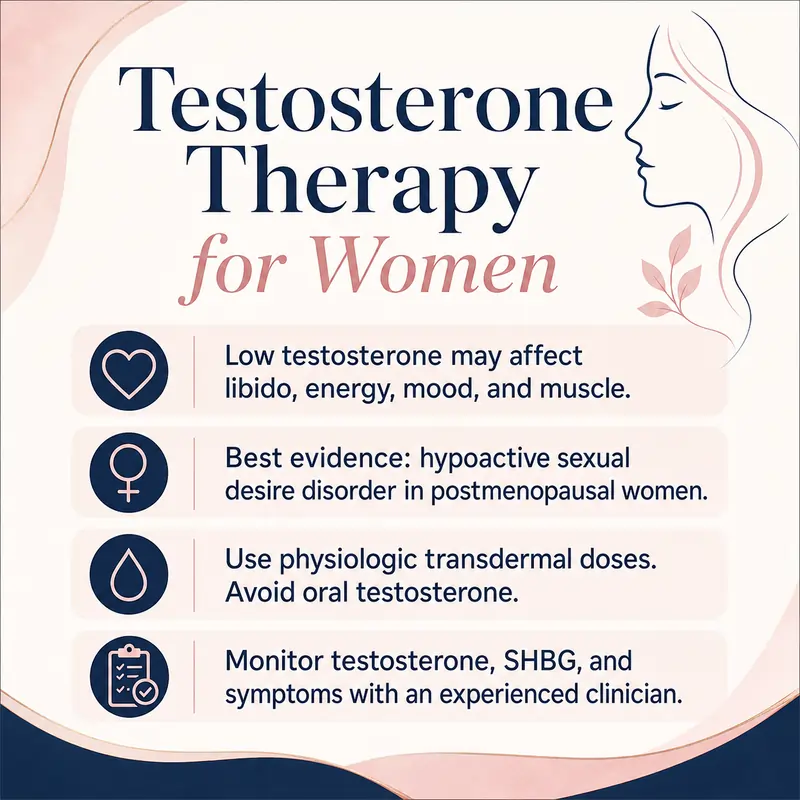
Testosterone is NOT a "man's hormone"
Women produce testosterone in the ovaries and adrenal glands, and it's a key driver of libido, mood, energy, cognition, muscle mass, and bone density. Levels begin to fall in a woman's 30s and continue to decline through perimenopause and menopause — yet most women are never offered testosterone testing or testosterone therapy, even when they suffer from symptoms.
Low Libido in Women: Testosterone Therapy's Strongest Evidence
The only guideline-endorsed indication for testosterone therapy in women is hypoactive sexual desire disorder (HSDD) in postmenopausal women.
A 2019 meta-analysis of 36 clinical trials in over 8,000 women confirmed that transdermal testosterone, at physiologic doses, significantly improves sexual desire, arousal, orgasm, pleasure, and sexual self-image — with women experiencing approximately one additional satisfying sexual event per month over placebo. Practice guidelines agree that physiologic dosing via transdermal routes should be trialed for 3–6 months.
There is no FDA-approved testosterone product for women in the United States. All testosterone therapy for women is prescribed off-label, using either male formulations adapted to female doses or compounded preparations. Doctors at Clarus Health discuss the risks and benefits of testosterone therapy in women as part of comprehensive bioidentical hormone replacement therapy (BHRT) with physiologic doses, non-oral routes, and full lab monitoring.
Testosterone Therapy in Women for Mood and Brain Fog
Women ask about testosterone for mood, energy, and brain fog more than any other reason — and the evidence is mixed.
A 2020 placebo-controlled clinical trial of 101 women with treatment-resistant depression found no benefit of testosterone over placebo. However, a 2025 retrospective study of 510 women on HRT reported significant improvements in mood (47% of women) and cognitive symptoms (39% of women) after 4 months of transdermal testosterone.
Testosterone therapy in women for mood and cognition remains off-label and not yet supported by randomized trial evidence. Some women respond. Others do not. Any medication trial should include clear criteria for stopping if benefit doesn't emerge within 6 months.
Testosterone and Bone, Muscle, and Body Composition in Women
Testosterone plays a meaningful role in muscle protein synthesis, bone density, and body composition in women. Despite this, controlled trials at physiologic doses have shown no significant effect on bone mineral density, lean body mass, or muscle strength over 12 months.
The catch: these trials were small, all participants were on concurrent estrogen, and none enrolled women with osteoporosis or sarcopenia — the populations most likely to benefit. The 2019 consensus explicitly called for adequately powered trials in these higher-risk groups, similar to the 2022 Menopause Society Hormone Therapy Position Statement. Until those studies are completed, testosterone should not be prescribed for bone or muscle goals as a primary indication.
Testosterone, Heart Health, and Metabolism in Women
Two safety points every woman considering testosterone therapy should know:
- Non-oral routes (transdermal cream, gel, or carefully monitored subcutaneous protocols) are not associated with increases in blood pressure, glucose, or HbA1c in short-term trials — per the 2019 consensus and supported by the 2019 meta-analysis, which showed no adverse cholesterol effects, either.
- Oral testosterone is not recommended because it worsens cholesterol on first pass through the liver.
A 2024 large claims-database analysis suggested testosterone users may have lower rates of major adverse cardiovascular events, blood clots, and breast cancer, though this observational data cannot prove causation.
Testosterone Therapy and Breast Cancer Risk
Short-term transdermal testosterone use does not appear to increase breast cancer risk and does not increase mammographic density, per the 2019 international consensus.
A 10-year study of 1,267 women treated with testosterone lower rates of breast cancer than expected (11 cases of invasive breast cancer compared to 18 expected based on national cancer registry rates). This correlates with the claims-database study, suggesting a possible protective signal. While thought provoking, major medical societies are clear: there are no data supporting testosterone for breast cancer prevention, and caution is warranted in women with hormone-sensitive breast cancer.
What "Normal" Testosterone Labs Miss in Women
Most doctors don't measure testosterone in women at all. When it's measured, the immunoassays used by standard labs are highly unreliable at the levels typically found in women. The 2019 international consensus explicitly recommends total testosterone in women be measured using mass spectrometry — a technique most conventional labs don't use by default.
Every woman considering testosterone therapy with our doctors receives a comprehensive evaluation as part of our bioidentical hormone replacement therapy program. We measure:
- Total testosterone by mass spectrometry, free testosterone, and SHBG
- DHEA-sulfate, full estrogen and progesterone panels, comprehensive thyroid
- Advanced lipids, inflammatory markers, metabolic biomarkers, and more
- Genomic factors including COMT, MTHFR, and 50+ more that affect how your body processes hormones
We interpret your data against where your body should be — not against a population average. Because "normal" isn't the goal. Optimal is.
Starting Testosterone Therapy for Women in San Francisco
If you're experiencing symptoms of hormone imbalance and wondering whether testosterone therapy could help, a thoughtful evaluation — not a guess — is the starting point.
Schedule a complimentary consultation today with one of our doctors to discuss your longevity goals.

Anthony Kaveh MD
Dr. Kaveh is a Stanford and Harvard-trained anesthesiologist and integrative medicine specialist. He has over 1,000,000 followers on social media and has guided hundreds of patients throughout transformative healing experiences. He is an authority on Ketamine, NAD, SGB, and genomics-guided therapies. He is a continuing medical education lecturer in the Bay Area.