Ketamine and Stellate Ganglion Block for Trigeminal Neuralgia
Explore potential rapid and sustained therapies for trigeminal neuralgia to relieve pain and restore quality of life
Clarus Health offers the following for patients living with trigeminal neuralgia and other severe facial nerve pain:
These therapies can help fundamentally "re-wire" pain loops to give safe results. They have decades of clinical, off-label use despite not having FDA approval for the treatment of trigeminal neuralgia.
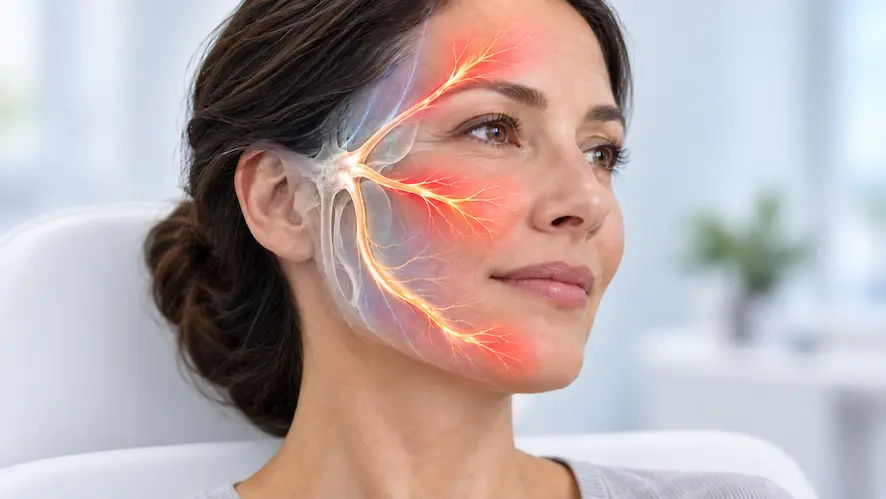
Trigeminal neuralgia produces some of the most severe pain described in medicine, with attacks that can make eating, speaking, and even a breeze against the face unbearable. Carbamazepine remains the first-line treatment, but the European Academy of Neurology guideline reports an approximately 50% failure rate for long-term pain control along with adverse effects including drowsiness, dizziness, ataxia, rash, and liver injury, which is why so many patients eventually find themselves choosing between the pain and the medication meant to treat it.
IV Ketamine for Trigeminal Neuralgia
Years of trigeminal pain change how the nervous system processes signals from the face, and that amplification is driven largely through NMDA receptors in the brainstem. IV ketamine blocks those receptors directly, interrupting the amplification itself rather than simply dampening signals the way an anticonvulsant does, which is the basis for its established role in refractory neuropathic pain. Dose and duration matter substantially here. When researchers reviewed ketamine across craniofacial pain conditions, single low-dose injections produced inconsistent results while prolonged infusions showed sustained improvement, and the authors attributed the difference to how the drug was delivered. Clarus Health follows the multi-society consensus guidelines for infusion dosing in chronic pain, and response tends to be strongest in patients whose facial pain has become constant or burning rather than purely paroxysmal.
Stellate Ganglion Block for Trigeminal Neuralgia
The stellate ganglion controls sympathetic supply to the face, and in many facial pain conditions the sympathetic nervous system becomes an active driver of pain rather than a bystander, a pattern described across orofacial pain disorders including postherpetic neuralgia and atypical facial pain. Blocking that ganglion with local anesthetic quiets the loop, and it answers a diagnostic question quickly: substantial relief within minutes of a single block identifies a sympathetically maintained component, which has been reported in refractory trigeminal neuralgia and in a cohort of patients with treatment-resistant facial pain treated with ganglion block series. Relief from one block may be short-lived, so Dr. Kaveh plans around a short series and reassesses rather than simply repeating a procedure.