Estradiol Cream vs Estradiol Patch: Which is Better?
Is estradiol cream better than the estradiol patch? Here's the winner.
*IV Ketamine, NR, and NAD+ have been used clinically off-label for decades. They are not FDA approved for the treatment of any psychiatric or pain condition. All medical treatments carry risks and benefits that you must discuss with a doctor at Clarus Health to learn if these therapies are right for you.

Estradiol Cream vs. Estradiol Patch: Which Is Better?
Hormone replacement isn't optional for most women - it can be life saving. But which hormone replacement is better: the estradiol cream or the estradiol patch? The answer depends on the woman and their specific symptoms and health history. Estradiol cream treats symptoms in the vagina and bladder, while the estradiol patch treats the whole body. Here's Dr. Kaveh's breakdown of this key question all women should discuss with their doctor:
What Is Estradiol Cream?
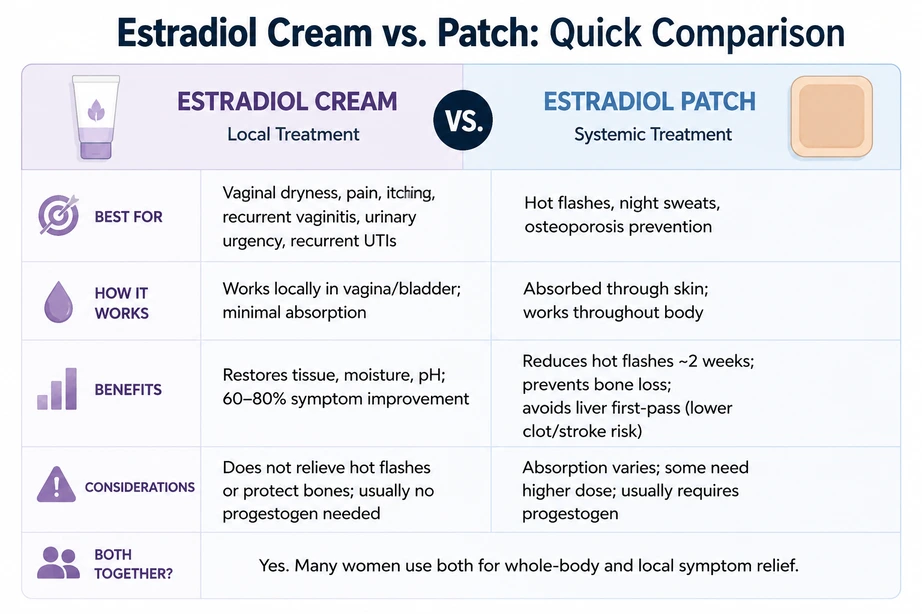
Estradiol cream is a local treatment that you apply directly to vaginal tissue, where it works on the genitourinary syndrome of menopause. Estradiol cream targets:
- Dryness and itching
- Painful sex
- Recurrent vaginitis
- Urinary urgency
- Repeated urinary tract infections (UTIs)
Estradiol cream rebuilds the vaginal lining, restores moisture and natural secretions, and brings the vaginal environment back to its normal acidic pH, giving most women roughly a 60-80% improvement in these symptoms. Very little estrogen reaches the bloodstream, so estradiol cream does little for hot flashes and offers no meaningful bone protection. Because it stays local, vaginal estradiol is used specifically for genitourinary symptoms, and current guidance recommends local therapy first when vaginal symptoms are the only complaint. This is also much safer in women who should not be given body-wide hormone replacement therapy (HRT).
Compounded Estradiol Creams
You may hear about systemic estradiol creams from compounding pharmacies. These creams are applied to skin or vaginal or labial tissue and can have body-wide (systemic) effects. However, these are much less common than FDA-approved vaginal estradiol creams. Speak with a doctor at Clarus Health to learn about these alternative estradiol cream options.
What Is an Estradiol Patch?
The estradiol patch is a systemic (body-wide) treatment that sends estradiol through the skin into the bloodstream, which makes it the tool for the whole-body symptoms of low estrogen. An estradiol patch targets:
- Hot flashes
- Night sweats
- Prevention of postmenopausal osteoporosis
At standard doses the estradiol patch cuts hot flashes substantially, and most women feel the benefit within about two weeks. It improves vaginal symptoms too, though less reliably than an estradiol cream. Menopausal hormone therapy is the most effective treatment for hot flashes and night sweats, and the estradiol patch delivers it while avoiding the first pass through the liver that raises clotting and stroke risk with swallowed estrogen.
When Estradiol Cream Is the Right Choice
Estradiol cream tends to be the better option when:
- Dryness, painful sex, itching, recurrent vaginitis, urinary urgency, or repeated UTIs are the main problem, and hot flashes are not part of the picture
- You want to keep estrogen exposure local and skip the added progestogen that systemic therapy usually requires
- A women cannot be given system estrogen, such as women with a recent history of breast cancer
A common approach with estradiol cream is daily use for one to two weeks to restore the tissue, followed by a low maintenance dose kept up over the long term.
When an Estradiol Patch Is the Right Choice
The estradiol patch tends to be the better option when:
- Hot flashes, night sweats, or bone loss are present
- You have obesity, high triglycerides, or a higher baseline risk of blood clots, all of which make the patch preferable to oral estrogen
- You had early onset of menopause (like from surgery)
The Estradiol Patch Dosing Problem Almost No One Mentions
Estradiol patch dosing is complicated because women absorb estrogen differently through the skin - it depends on skin moisture, exercise and sweat, ethnicity, hydration status, and more. Two women can wear the identical patch at the identical dose and end up with blood levels that differ by as much as tenfold. A 2026 clinical review spells out what that means in practice:
- The lowest genuinely effective dose is a higher, sometimes off-label dose for up to 1 in 4 women on an estradiol patch
- Close to 1 in 3 may never reach bone-protective levels on the lower standard doses
A woman can wear her patch and have "normal" blood levels but not be receiving full benefits because she's actually underdosed
So a standard estradiol patch dose is really a starting point. A woman can wear her patch, still feel her symptoms, and be told her blood levels look "normal," when in reality she absorbs estrogen poorly and needs a higher dose or a different delivery method to reach a level that works for her. The answer is individualized dosing, which means adjusting to how you actually feel and, where it helps, confirming your level with bloodwork rather than assuming the label dose is doing its job. This is why personalization is key, and it is how we approach bioidentical hormone replacement therapy in San Francisco, matching both the dose and the delivery method to your body and your symptoms.
Using Estradiol Cream and the Patch Together
Plenty of women end up using both cream and patch together. Someone on an estradiol patch for hot flashes or bone protection can still have lingering vaginal dryness, because the estrogen level that quiets hot flashes does not always reach vaginal tissue in high enough amounts. Adding a low-dose estradiol cream alongside the patch is a common and sensible combination that covers the whole-body and the local problem at once.
Estradiol Cream and Patch Safety: A Few Things Worth Knowing
- Estradiol cream carries the same boxed warning as full systemic hormone therapy, even though the evidence has not linked low-dose vaginal estradiol to higher rates of breast or endometrial cancer, heart disease, stroke, or clots. The warning is controversial as a labeling holdover versus a measured risk.
- Compounded estradiol creams are a separate product and a frequent source of confusion, because they deliver noticeably lower estrogen exposure than FDA-approved patches and gels at comparable doses. A compounded cream may not be as reliable as an estradiol patch.
- For women with a history of estrogen-sensitive cancer, non-hormonal moisturizers and lubricants come first, and any hormone decision should involve your oncology team.
- Whatever route you use, bleeding after menopause always needs to be evaluated.
Estradiol Cream vs. Estradiol Patch: Which Should You Try First?
Estradiol cream and the estradiol patch solve different problems. If your symptoms are confined to the vagina and bladder, estradiol cream is usually the smarter, lower-exposure option. Most women will experience systemic symptoms eventually, like hot flashes, night sweats, or bone loss, and the estradiol patch is the right tool - but it must be dosed to you rather than a default dose because many women remain under-treated. Contact Clarus Health today to start your individualized bioidentical hormone replacement therapy in San Francisco.

Anthony Kaveh MD
Dr. Kaveh is a Stanford and Harvard-trained anesthesiologist and integrative medicine specialist. He has over 1,000,000 followers on social media and has guided hundreds of patients throughout transformative healing experiences. He is an authority on Ketamine, NAD, SGB, and genomics-guided therapies. He is a continuing medical education lecturer in the Bay Area.